
The Ultimate Guide To Practice Triads On Guitar: 5 Easy Steps!

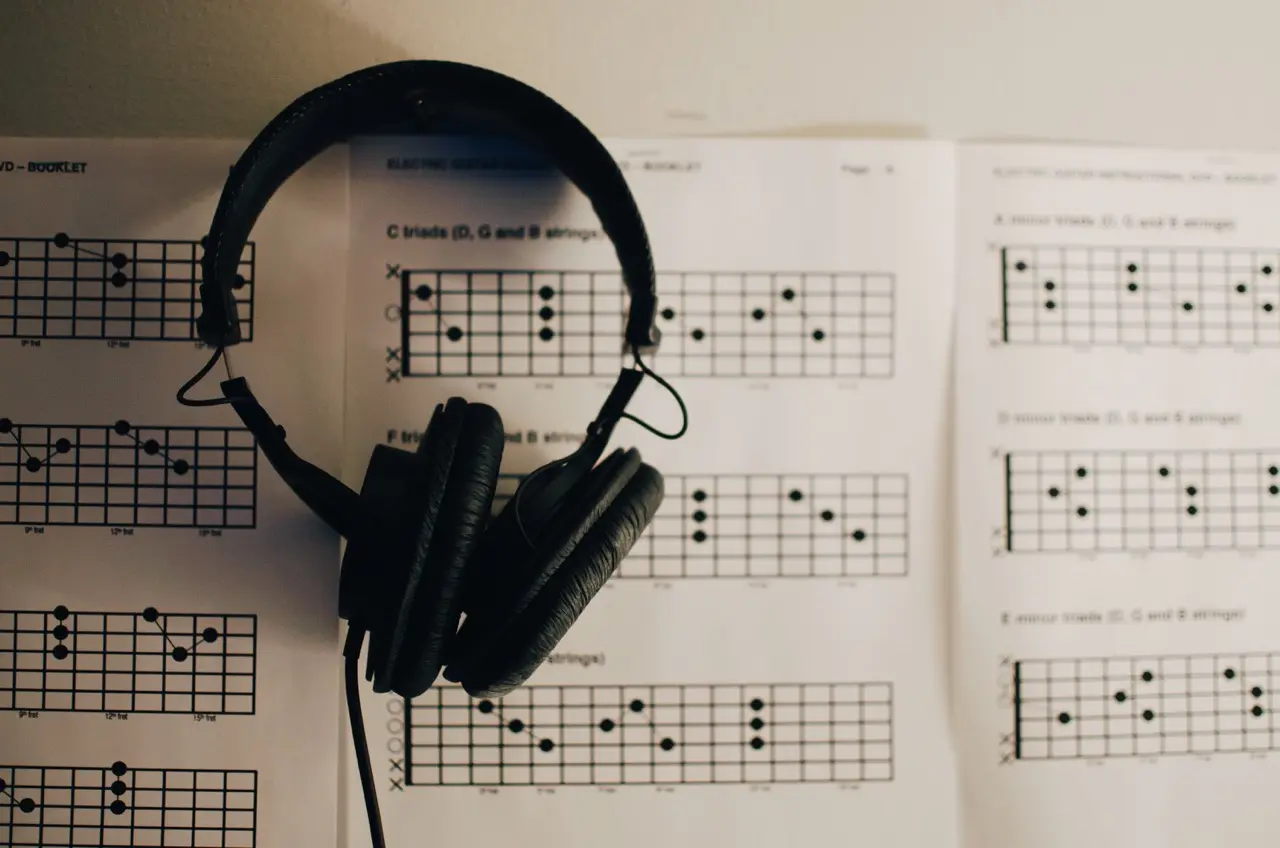
headphones resting on sheets of guitar diagrams all about triads

Guitar lessons often focus on teaching triads, but it’s equally as important to know how to practice triads on guitar. Memorising triad shapes is just the beginning, but in this lesson we’ll build on a simple practice idea that you can incorporate in your daily routine.

This lesson assumes you’re already at least moderately familiar with how to visualise triads on guitar. If this is not something you’re yet confident with, I recommend enrolling in my CAGED Fretboard Visualisation Masterclass for a complete insight into how to visualise the guitar.

Let’s begin working through the steps!

#1: Determine The Chords & Key

Let’s start by selecting two major triads within a specific key. For example, we’ll choose the key of B and the B major triad as our starting point. To create a musical progression, we can select the B major and E major triads – the I and IV chords.

#2: Playing with a Steady Tempo

Set a steady tempo that works for you and play a B major triad on every quarter beat. Maintain this pace for four bars.

TOP TIP: If you find that you’re better at visualising triads vertically on guitar, and not so much horizontally, try to loop one or two triads for a few beats whilst you allow yourself to think and work out a different position of the neck. Once you can visualise triads in your target position of the neck, then take the leap! Horizontal movement can be slow to begin with, but in time when your ability to visualise the guitar strengthens, you’ll become much faster.

Now after 4 bars of E major, move on to to the next chord (B major) for the next 4 bars and play B major triads on every quarter beat.

Rinse & repeat!

#3: Adding Chords & Increasing Difficulty

To add complexity, we can add chords to the progression. To allow yourself to focus on major triads, adding a V chord to the progression would be the smartest decision.

For now, don’t add any other triad types to your progression such as minor triads. We’ll come back to that later once you can be sure you master the major triads.

You may also decide to speed up the progression if you find it to be too easy or slow. Instead of playing 4 bars of each chord, you could play just two bars. If you’re feeling confident with your rhythm, then perhaps you can introduce some eighth notes instead, or off-beat rhythms.

Just don’t run before you can walk!

#4: Minor Triad Variation

Now that you’ve got a good grasp of how major triads look and feel across the neck, it’s time to regress back to step #1 again but now with minor triads. Begin with a i iv progression, Bm to Em.

The goal is to focus on one type of triad during a practice session to maintain clarity and progress.

#5: Putting It All Together

After you’ve become confident with both major and minor triads across the neck, it’s time to blend them together! If you’ve done sufficient preparation, this shouldn’t be too difficult to improvise your way through.

Major and minor triads are the most important triad types to familiarise yourself with. Down the road, you can begin to expand your chord vocabulary with diminished, suspended, and even augmented triads. I would advise that you stick with major and minor for a long while though, as these are the most practical and useful.

Embrace the learning process and enjoy the journey 💜

If you want to deep dive further and not only learn other ways on how to practice triads effectively, but also how to apply them in your music and improvisation, you absolutely don’t want to miss out on my All About Triads Masterclass here on Fretwise! 😉

Target Chord Tones: 2 Transformative Examples With The CAGED System

target chord tones

If you want your solos to sound less like scales, and more in alignment with the chords, then you need to learn how to target chord tones! The best tool to help visualise chord tones on guitar is The CAGED System. It’s without a doubt one of the most vital things to learn on your guitar journey.

In the video above, I share with you a preview from my CAGED Fretboard Visualisation Masterclass, where we will explore how to apply The CAGED System over chord changes. While many guitarists think about key centers and scales when playing over chord progressions, it’s crucial to recognise that not all notes are equal. Some notes are stronger and more stable than others, and this is a continuously changing factor chord progressions.

There are two examples that I want you to explore and consider in your music practice.

Example 1: Scales

Consider a I-IV-vi-V progression in E major. Regardless of the progression, most guitar players would opt to solo using notes from the E major scale or E major pentatonic scale. While this works fine, you may notice that some notes from the scale sound better over certain chords more than others.

You can test this out yourself by playing what you consider to be a good lick over every chord. You’ll notice that that same lick won’t sound equally as good over all of the chords. So, what’s the problem? Well, the function of the notes you play change on a per-chord basis. Over one chord, the lick will be more complimentary of the underlying chord. Over another chord, perhaps not so much. To fix this, we need to consider chord tones.

Example 2: Target Chord Tones

To play chord tones, it’s important that you’re able to visualise the notes of the underlying chord in addition to your chosen scale, as a separate and independent musical device. If you’re able to do that, then you will have the power to alternate between chord tones and tension tones on command.

The easiest way to visualise the chord tones that belong to each chord is to practice visualising the triad arpeggios that correspond to each chord. The CAGED System is the best tool for this, as demonstrated in my CAGED Fretboard Visualisation Masterclass.

A good way to practice this is to consider the “parent” scale, for example the major pentatonic scale, to be your safety net. On occasion, step out of that safety net to target tones from each of the underlying chord. Ideally it’s best to hit these chord tones notes on the first beat of each bar or chord. This demonstrates to the listener that you’re closely following the chord progression.

How To Practice Chord Tones

I recommend practicing these skills in one small position of the neck. Avoid jumping around the neck to find chord tones. Instead, try to identify the chord tones of each chord in one position of the neck. Once you’re able to do this confidently, you can move on to another position of the neck. By using The CAGED System, you’ll be able to identify 5 critical positions of the guitar neck.

Gain A Deeper Insight Into The CAGED System

If you would like to learn more about chord tones and The CAGED System, consider joining my most popular course on Fretwise: the CAGED Fretboard Visualisation Masterclass! It’s designed to help you master The CAGED System and gain a deeper understanding of music theory, fretboard visualisation, and more. For me, the knowledge shared in this class has revolutionised my perspective and understanding of the guitar!

Until next time – keep practicing, and stay curious 🏆

How to Solo Using Chord Tones: Learn to Navigate Chord Changes

How to solo over chord changes & target chord tones

The majority of guitar players, when asked to solo over a progression, will typically gravitate to play the minor pentatonic scale as their go-to selection of notes. This is a great choice, but after a while you might begin to notice that it sounds repetitive and much akin to a bag of licks.

In the video lesson, we will fix these problems by learning how to solo WITH chord progressions versus OVER them. I’ll show you which chord tones to aim for, and where to find them.

The trick is to complement the chords by targeting specific intervals as you navigate through the changes 🤫 You can do this in combination with the familiar pentatonic scale.

In the video, I use the chord progression from John Mayer’s “Slow Dancing In A Burning Room” which uses the chords:

  • C#m | A – E.

How To Find Chord Tones

Here’s the familiar pentatonic scale that you can use over the chord progression:

When soloing over the C#m chord, you should emphasise the root, minor 3rd, and 5th:

As you transition to the A chord, direct your attention to the minor 6th, root, and minor 3rd:

These intervals are relative to the key, but in practice you should start to think of them as an A major triad inside of the pentatonic position.

Finally for the E chord, direct your attention to the minor 3rd, 5th, and minor 7th:

Again, this is better thought of as an E major triad since that’s what the function of the notes are in relation to the underlying chords.

Visualise Chord Tones with the CAGED System

If you have any experience with the CAGED system, you might have noticed that the intervals highlighted in the images above outline popular CAGED shapes.

The CAGED system is immensely helpful for visualising and quickly locating chord tones across the neck. Learn how to leverage the CAGED shapes to easily find the desired chord tones for each chord in a progression. With great practice, you’ll eventually be able to used CAGED to locate all intervals in all positions of the neck!

If you’re not familiar with the CAGED system, I recommend you checkout my CAGED Fretboard Visualisation Masterclass.

Tension & Release

You don’t need to hit every chord tone, all the time, but even trying to highlight just one at the beginning of each chord change can make a significant impact on your soloing and musical expression!

The goal is to strike a balance between tension and release. The release is the chord tones, and the tension can be notes that belong to the key but not the chord. Be aware that constant release can sound predictable and uninteresting, and constant tension can sound boring and irrelevant.

Voice Leading Between Chords

When practicing this for the first time, I find that students most often begin each bar/chord by starting on the root notes. Try to avoid this! Voice lead through the progression instead. This means that as you end your melody on one chord, begin the next chord by choosing the closest available chord tone instead of leaping to the root note.

Summary

  • Consider the pentatonic scale as your safe space. For each chord you play over, it’s your job to emphasise the notes that belong to the chord in addition to the pentatonic scale.
  • Timing is key! You’ll notice that playing a chord tone at the beginning of a chord change sounds very powerful, but chord tones that are played in the middle of a bar aren’t so much.
  • Not all chord tones are equal! Root notes will always sound the strongest, followed by the 3rd, and lastly the 5th.
  • Focus on smooth voice leading between chords and emphasising the changes.

Keep practicing and have fun exploring the art of soloing over chord progressions. Remember to listen attentively to the chords as you play and adjust your phrasing and note choices accordingly. Developing this musical sensitivity will greatly enhance your soloing skills and help you connect deeply with the music.