The Best Way to Visualise Triads on Guitar

the best method for visualising triads on guitar

Are you learning how to visualise triads on guitar, but struggling to see how they fit together across the fretboard? Let me show you the easiest way to visualise triads across the guitar neck!

Just like most of us, I first learned triads from a YouTube video. The teacher even provided accompanying PDF diagrams! For weeks thereafter I practiced them up and down the neck, hoping that eventually I would retain the muscle memory to recall all of the triads with ease. However this goal proved to be unobtainable, as it was too difficult to memorise much more than 10% of the shapes 😓

Years later however, I discovered a much easier method that I use to visualising triads (and, well – everything!) across the guitar neck: The CAGED System.

The CAGED System

If you are unfamiliar with The CAGED System, it consists of five positions or chord shapes that are movable positions across the guitar neck. These positions are based on simple open chords:

C, A, G, E, and D.

Let’s begin exploring what a D chord looks like by identifying the five CAGED positions on the neck. Take note of how each position fits together like a jigsaw puzzle, and pay close attention to the root notes within each shape:

How To Visualise Triads

Now here’s the trick. Instead of memorising every individual triad position as its own, it’s far easier to think of them as subsets of their parent CAGED position!

For example, if you focus on just the bottom 3 strings, whilst keeping the parent shapes from above in mind, these are the note groupings you would practice:

Then once you can visualise these clearly, respective of their parent CAGED position, you can move on to do the same for every other string set!

Summary

Everything I’ve covered in this writeup is relative to the key of D major. In the attached video I also go through examples in C major.

If you want a more comprehensive understanding of The CAGED System including how to practice triads in every key, including minor keys, then take a look at my CAGED Fretboard Visualisation Masterclass! The methods I teach in this course have revolutionised my outlook of the guitar đŸ€Ż

By utilising The CAGED System properly, you’ll be able to effortlessly and quickly recall triads during your practice within no time!

The Best Way To Hold A Guitar Pick: With Pictures!

best way to hold a guitar pick

Knowing how to hold a guitar pick properly is a crucial foundational skill in guitar playing – developing good habits here will prevent problems with advanced techniques down the line.

I’ve received countless comments from people who have watched the video above expressing that bad habits have hindered their progress, and that inheriting my tips has tremendously improved their speed and accuracy on the guitar.

I will start this off with an important disclaimer though. I realise that there is no “best way” that suits absolutely everyone! There will always be exceptions to the rule, but the tips I am sharing with you in this post are what I’ve found to be most helpful for the majority of people.

Take what you will from this post, even if it’s just one or two tips. Learning to pick properly will feel a little unnatural at first, just like most new skills. In the early stages of your progression, try to find a compromise between what feels comfortable and what feels right.

A small and strong pick with a sharp tip will set you off on the right track! I’ve tried countless over the years, and I always come back to the Dunlop Jazz III picks.

Picking Grip

First and foremost, hold your pick between your thumb and your first finger. Avoid using two fingers or relying solely on the middle finger. Utilise the thumb and finger for a stable grip.

Make sure the pick rests on the side of your first finger, not the flat part. The tip of the pick should face the same direction as your nail.

A common mistake is pinching the pick between the thumb and finger, in the same way you would pinch your nose.

Instead, aim to create a circle, as demonstrated in the next image.

Keep the other fingers slightly separated from the pick to reduce friction and unnecessary tension. By curling them up, you create a noticeable gap between the second and first finger.

I like to think of holding a guitar pick much like holding a pencil or paint brush.

Wrist & Finger Position

Next, remember to keep your wrist loose and relaxed. Avoid any tightness or tension in this area.

Now that you have a grasp on holding the pick, establish a reference point on the guitar bridge. I like to rest the ball part at the base of your palm on the top of the guitar bridge, and align the entire side of your palm down the bridge.

This position helps with accuracy. Avoid starting with your arm sideways, as it can lead to issues in playing accurately.

By aligning yourself properly with the bridge and having the ball of your hand on top, you’ll increase your chances of hitting the right notes at the right time 😉

Remember that this is a picking lesson, and the same rules don’t apply if you’re strumming. When strumming you do not want to anchor on the bridge. The pick grip remains the same, but there must be no anchor point on the bridge.

Picking Angle

Now that your hand is in the right place, your goal is to attack the strings at a 45 degree pick angle.

Don’t confuse picking direction with pick angle. Picking direction should naturally be vertical – up and down as you cross over the string. Picking angle though refers only to the angle of the pick.

It’s important that both your wrist and fingers are flexible and move with the motion of the pick.

Summary

By combining these reference points and the proper pick hold between your thumb and finger, you’ll establish a solid foundation for picking.

As a beginner exercise, try picking each string individually, gently moving the pick down and up. Focus on these key points rather than speed. Pay close attention to my demonstration in the video.

These tips encapsulate what I believe to be the most beneficial and comfortable methods from my favourite guitar players. I hope they help you as much as they’ve helped me and hundreds of thousands of other viewers around the world!

Keep practicing and good luck with your guitar journey!

Positive Grid Spark 40 Amp: Review

Positive Grid SPARK 40 Amp

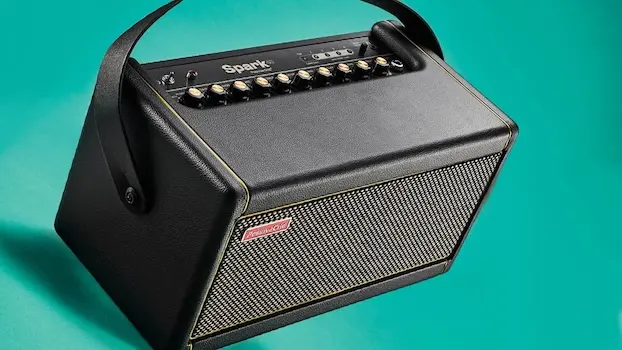
The Positive Grid: Spark 40 Amp may look like a small head unit, but it’s actually a powerful 40 watt practice amp that features two speakers in the front! If you’d like a Spark amp review, listen in to the video above for a hands on experience, and multiple demonstrations of what it actually sounds like!

6 Best Features Of The Spark Amp

#1: Smart Band on Demand

When coupled with the free Spark app on iOS or Android, the Spark listens to your playing style and creates drums and bass that play along with you. It’s like having your own smart, virtual band on demand.

Unfortunately, at the time of writing this I was not able to test this feature, but it looks promising and would be an excellent resource for improvisation and impromptu performances.

#2: Play Along with Songs

Using the Spark app, you can play songs directly from YouTube, Spotify, or Apple Music, and the app will even detect the chords for that song. You can then play along at your own pace!

#3: Voice Command

Through the Spark app, you can voice command the amp to play a specific song, provide a backing track, or have your virtual band accompany your performance.

#4: Powered by Bias Engine

The Spark is powered by the Bias engine, offering incredible versatility with sounds, genres, and styles. Using the app and the dials on the unit, you can dial in your favourite tone from various styles. Additionally, the app provides access to Positive Grid’s Tone Cloud, boasting over 10,000 presets for you to explore. You can also share your own custom tones on the Tone Cloud.

#5: Direct Recording

You can connect the Spark 40 directly to your computer or digital audio workstation via USB for high-quality, hassle-free recording. No need for microphones, as you’ll get professional studio tones without any setup complications. It’s essentially an amp with its own built in audio interface!

#6: Instrument Adaptability

Lastly, the Spark isn’t limited to electric guitars. You can also plug in acoustic or bass guitars, and the settings on the unit can be adjusted accordingly. The Tone Cloud offers instrument-specific presets for even more customisation options.

Demonstrations

In the Youtube video attached to this post, I demonstrate the sound of the Spark amp through a microphone. This will give you a better idea of how the Spark amp sounds straight out of the box!

When Are Notes Sharp Or Flat?

sharp or flat notes on guitar

Have you ever wondered what the distinction between sharp and flat notes is, and when it’s more appropriate to use – for instance, a Db instead of a C#? They’re the same note right, so why does it matter?

With my demonstrations in the video above, I will help you grasp the contexts in which you should use either a sharp or flat note.

Example 1: Common Practice

If we were to put together an F major scale, would it be:

  • F, G, A, A#, C, D, E; or
  • F, G, A, Bb, C, D, E

When the full scale is written out, it might already seem clear to you which one is the correct answer. The second option uses all letters of the musical alphabet, whereas the first skips a letter which goes against common practice.

Example 2: Theoretical Notes

This rule also applies when a note only theoretically exists. Consider for example the D# harmonic minor scale, which is built from the intervals: 1, 2, b3, 4, 5, b6, 7.

Take note that this is a natural minor scale, but instead with a sharpened 7th degree.

This would be an incorrect interpretation:

  • D#, F, F#, G#, A#, B, D.

Instead, we would do this:

  • D#, E#, F#, G#, A#, B, C##.

Notice that E# is a theoretical note, and while C## is technically the same as D, we can’t skip a letter in heptatonic scales.

Summary

The confusion on whether a note is sharp or flat usually comes from a scenario with no context. If you select a random note on the fretboard, it could for example be either D# or Eb. Without context, it’s unclear. So be sure to understand the context of the music if you’re in doubt!

Build Chords On Guitar: Everything You Need To Know

Build Chords on Guitar

In this post I will teach you everything you need to know about how to build chords on guitar for a solid foundation of chord theory. đŸ’Ș

We’ve all been there, looking at a complicated chord written down (Am7b9#13no5), feeling lost, and resorting to playing the simplest form. However, once you grasp how to read these chord notations, you’ll be able to confidently tackle even the most intricate chords. That’s precisely what this video is all about —breaking down the primary chord types and decoding chord notations.

Before you dive in, it’s necessary that you are familiar with intervals on the fretboard, like recognising intervals such as 1, 3, 5, and 7. If you need to strengthen your interval knowledge, I go through this extensively in my CAGED Fretboard Visualisation Masterclass.

By the end of this lesson you will know how to build chords on guitar.

Chord Types

We can break down all chords into three types. Take note to how each version builds upon the previous chord type:

1. Triads

Triads are basic chords consisting of three notes, all stacked in thirds. There are four essential types:

  • Major Triad: 1, 3, 5
  • Minor Triad: 1, b3, 5
  • Augmented Triad: 1, 3, #5
  • Diminished Triad: 1, b3, b5

You may be familiar with Suspended Triads, but these aren’t amongst the essential four because they actually deviate from traditional harmony because they do not comprise of stacked thirds:

  • Suspended 2 (sus2) Triad: 1, 2, 5
  • Suspended 4 (sus4) Triad: 1, 4, 5

All of these triads form the foundation for more complex chords.

2. Seventh Chords

Seventh chords add a fourth note to triads, the seventh degree. There are five primary seventh chord types to know:

  • Major 7: 1, 3, 5, 7
  • Minor 7: 1, b3, 5, b7
  • Dominant 7: 1, 3, 5, b7
  • Minor 7b5 (Half Diminished): 1, b3, b5, b7
  • Diminished 7 (Full Diminished): 1, b3, b5, bb7 (double flat seven)

Seventh chords build upon triads, and make your chords vocabulary more colourful and jazzy.

3. Extended Chords

Extended chords incorporate additional notes – 9, 11, and 13 – above the octave (1). They are essentially seventh chords with extensions. For example:

  • Major 9: 1, 3, 5, 7, 9
  • Minor 9: 1, b3, 5, b7, 9
  • Dominant 9: 1, 3, 5, b7, 9

These chords stack an additional third onto seventh chords.

When encountering more complex extended chords, you may need to omit certain notes to make them playable on guitar. For instance, a Major 13 (1, 3, 5, 7, 9, 11, 13) has 7 notes, but guitars typically only have 6 strings. Thus to play this chord it would require omitting the 11.

Chord Modifiers

In addition to the chord types mentioned above, there are three chord modifiers that you should understand:

1. Add Chords

These simply add an extra note to a basic triad. For instance, Cadd9 includes the 9th degree (2) in addition to the triad.

The reason it’s notated as Cadd9 instead of Cmaj9 is because there’s no 7 in the chord. If there were a 7, “add” chords become extended seventh chords.

2. Modified Notes

Some chords include modified notes, like Cmaj7#11, where #11 is the modified note. This alters the chord’s tonality.

Cmaj7#11 could be constructed in a few ways on guitar:

  • 1, 3, 5, 7, 9, #11 (the most complete – does not imply best)
  • 1, 3, 5, 7, #11
  • 1, 3, 7, #11 (the most concise and clear)

3. Slash Chords

When you see a chord like C/E, it means a C chord with an E in the bass. In this instance, E is the 3rd degree of C major. That would make C/E the first inversion of a C major triad.

Slash chords don’t always need to contain notes of the parent chord. For example, C/D is a C major triad with a D in the bass.

Concluding Notes

Understanding these three methods of chord theory will allow you to decipher and play a wide range of chords effectively.

As you experiment and build different chord variations across the neck, you’ll enhance your chord-playing skills and broaden your musical horizons. Chords are the building blocks of music, and mastering them opens up endless possibilities for your playing.

Master Scales Inside & Out With These 4 Exercises!

Master Scales on Guitar

Most guitar players practice their scales in a mundane routine of running up and down the shapes, but it’s time to shake things up and make your practice more exciting and effective with a fresh approach!

In the video above, I’ll introduce you to the best scale exercises for the ultimate scale practice, to not only give you some practical ideas on how to boost your overall awareness of note relationships, but also to help you truly master scales and learn intervals. Let’s see how well you really know your scales 😏

Throughout the video, I’ll be demonstrating all exercises using the major scale within a single neck position. However, for those of you who’ve been following my CAGED Fretboard Visualisation Masterclass, you’ll soon discover how to apply these exercises to different positions on the neck while understanding the role of each note you play.

These exercises aren’t for the faint hearted, so brace yourself for this one 😉

Exercise 1: Thirds

Our journey begins with a straightforward yet essential exercise to broaden your scale knowledge. Start by playing your chosen scale, but don’t just focus on memorising the shapes! Focus your attention to the relationship between the intervals you’re playing, and how each note fits into the scale.

In exercise 1, you will sequence through the scale in thirds. Here are the four variations I demonstrate in the video:

  • Ascend the scale in ascending thirds;
  • Alternate the direction of thirds as you ascend. For example, ascend a third from 1 – 3, then descend a third from 4 – 2, then 3 – 5, 6 – 4, and so on;
  • Descend the scale with ascending thirds;
  • Alternate the direction of thirds as you descend. This is the same as the second variation, except you’ll descend the scale instead.

Be sure to master these variations, as I will be reusing them throughout the next exercises!

I often tell my students to “say it as you play it”. Even better than that, try to hum or sing the intervals as you play them – that way you’ll also be training your ear! This exercise lays a solid foundation for the more exciting challenges ahead.

Exercise 2: Sixths

For this exercise we will increase the difficulty by expanding the relationship between notes. You will run through the same practice examples noted in exercise 1, but instead of thirds we will use sixths.

To clarify the alternating direction whilst ascending, you will play:

  • 1 up to 6
  • 7 down to 2
  • 3 up to 1
  • 2 down to 4

and so on. Remember to say it as you play it!

Exercise 3: Triad Arpeggios

Once again you will play each of the 4 demonstrations highlighted in example one, but with triads instead! This will begin to get much harder now, so don’t expect immediate results.

Exercise 4: Seventh Arpeggios

You know the drill by now! This is going to become very difficult by now, but is a real test of your interval knowledge and awareness.

Take your time! It’s ok to suck at this if it’s your first time! Persevere, and I promise that after a few weeks of practicing, you will have a much better perception of intervals on the neck!

Summary

In essence, these are the best scale exercises for a fresh and exciting approach to the ultimate scale practice, offering you a chance to enhance your awareness of intervals and notes of the guitar neck significantly. This will help you to break out of finger patterns and scale boxes, and instead make decisions much more intuitively without always depending on shapes.

Once you’ve gained proficiency in one key or area of the neck, feel free to venture into others or even explore the realm of minor keys! The possibilities are endless, and these exercises will undoubtedly prove to be a valuable stepping stone on your journey to master scales.

If you’re just starting out with these exercises, don’t be discouraged if it takes a few weeks to get the hang of them, especially as you explore different neck positions. If you’re looking for additional guidance, consider checking out my CAGED Fretboard Visualisation Masterclass. This class is all about interval visualisation across the neck and will give you the tools to work all the way from beginner to expert!

Master the Pentatonic Scale Across the Guitar Neck

A man trying to master the pentatonic scale on guitar

It’s no secret that in order to master the pentatonic scale, you need to learn how to play it confidently across the entire guitar neck. The pentatonic scale is a versatile and essential tool for creating beautiful melodies and solos, and it’s a must-know for any guitarist.

This is a two-part lesson that will not only show you the patterns across the neck, but also how to actually practice them! Playing the shapes up and down can be boring, so stick around for the second half of this lesson where I share with you actionable practice ideas that you can implement into your daily practice.

Part 1: Exploring the Five Forms

To learn the pentatonic scale effectively across the neck, we’ll break it down into five forms or patterns that interlink with each other like a jigsaw puzzle. These patterns will serve as the building blocks for developing your pentatonic expertise. These examples will all be from the perspective of the key: A minor.

Form 1 – Root Position:

Form 1 represents our starting point, also known as the root position. This shape will be your “home” position, and is something you will always be able to count on if you get lost on the guitar neck.

Form 2 – The Minor-Major Shift:

Form 2 reflects the parallel major key, C major. In the key of C major, this would actually be “form 1”. Context is very important in music!

Notice how this shape connects the previous one like a jigsaw piece. You’ll find that to be consistent for each form.

Form 3 – Expanding Your Range:

Form 3 begins on the minor 3rd of the A minor pentatonic scale.

Form 4 – Shifting the Starting Point:

Starting on the perfect 4th of A minor, Form 4 looks quite similar to Form 1 which hopefully makes it quite simple to remember! We’ll move this scale shape back an octave (12 frets) on the fretboard to give us more space.

Form 5 – Completing the Set:

Finally, Form 5 is the direct neighbour of Form 1.

Part 2: Breaking Free from Boxes

Once you’re starting to get confident at remembering the five pentatonic positions, you might find yourself feeling confined to rigid box shapes and patterns. In this section of the lesson I’ll share with you some practice ideas that can help you break free from these limitations and seamlessly blend these shapes across the guitar neck like the pros!

Horizontal Playing:

While vertical playing (up and down the neck) is essential, mastering horizontal playing is equally crucial. Start by isolating two strings at a time and explore each form exclusively in a horizontal fashion.

For example, start to play through the five forms on only the low B and E strings.

You can sequence the notes however you would like, and if you’re really daring then perhaps you can attempt to improvise on just these two strings!

After you feel confident at playing on this first string set, go through the same process on the next string set – the G and B strings.

Then of course onwards through each string set.

Skipping Forms:

Challenge yourself by skipping forms and taking larger jumps across the neck. You’ll soon find yourself quite confident at playing through the shapes when they’re all neighbouring, so try to force yourself to be less dependant on neighbouring shapes.

This exercise will encourage you to be less dependant on connecting shapes, but instead more focused on interval relationships and note positions.

Experimentation is Key:

Ultimately, the key to mastering the pentatonic scale across the entire neck lies in experimentation. Try different sequences, patterns, and combinations to find your unique voice on the guitar.

Conclusion

The pentatonic scale is a cornerstone of guitar playing, and mastering it across the entire neck will open up new avenues of creativity and expression in your music. Remember that there are no shortcuts to proficiency; it takes time, practice, and patience. So, start with these five forms, work on your horizontal playing, and experiment with different approaches.

The good news about learning guitar is that when you learn something once, it can be easily transposed to any key by simply moving all shapes respectively to the key. I believe it’s best to practice this kind of thing in short but frequent bursts.

If you want to delve deeper into your understanding of the pentatonic scale, and many more essential musical concepts, be sure to check out my Essential Theory For Guitarists masterclass!

Happy playing!