
How To Achieve Your Guitar Goals In 2024

Achieve Your Guitar Goals in 2024

I know from personal experience how tough it can be to achieve your guitar goals and improve as a guitar player. It takes a lot of time, practice and dedication to advance and without the right guidance or practice plan it’s easy to feel stuck.

In this post I will share some of the best methods for achieving your guitar goals to help you overcome any blockages on your learning journey:

First off, do you know what your guitar goals are?

If you do, I have some tips on how to best achieve them.

If you don’t, let me help inspire you to figure it out… and then achieve them!

Find Your Inspiration

Before you can set any goals, you need to find the source of your inspiration. What drives you to want to pick up your guitar and play? 

Do you have the desire to join a band?

Do you have a big dream of becoming a performer?

Do you want to be able to play your favourite songs?

Do you feel inspired by your favourite artists or bands?

Do you just enjoy the challenge of learning something new?

Take some time to reflect on what drives you to play, and use it as the foundation for your goals. 

If you admire a particular musician, start by carefully listening to their music and try to identify what makes their playing stand out to you. The unique combination of guitarists that you listen to, is how you’ll begin to carve out your own unique sound and identity on the guitar.

Outline Your Goals

Be specific and realistic. 

Instead of thinking, “I want to get better at guitar,” try thinking, “I want to learn two new riffs per week.” 

By setting specific, achievable goals, you can measure your progress and stay motivated.

Also, make sure you differentiate between your short-term and long-term goals. Smaller more immediate goals may take a week to achieve vs. larger, more ambitious goals may take months or even years.

This will influence your plan and approach. 

Create Structure

To achieve your goals, you’re going to need to create a structured plan. 

Decide how much time you can dedicate to practicing each week – again, be realistic, otherwise you won’t stick to it! Schedule that time into your calendar – make sure you set reminders.

It’s also important to create a structured practice routine. 

This could include warm-ups, music theory, technique-building exercises, or working on specific songs or riffs. By breaking your practice time into smaller, more focused segments, you can maximise your guitar learning efficiency.

Keep in mind that we all have different goals so no practice routine is the same.

Stay Disciplined

I understand that life can get busy, which is why it’s important your practice routine is realistic and matches your lifestyle. To reach your guitar goals, you will have to stay committed to your practice.

It’s like going to the gym, just more fun! 😄

If staying disciplined is something you struggle with, finding a fellow practice partner or joining an online community of guitarists (like Fretwise), can help keep you motivated and on track.

Challenge Yourself

While it’s important to set achievable goals, don’t forget to challenge yourself, you don’t want to be too comfortable. This could mean learning a more difficult song or even experimenting with a totally new style of playing. By challenging yourself, you can continue to grow and improve as a guitarist.

Track Your Progress

My favourite way to track my progress is to record myself play. Not only will that help you identify your areas for improvement, but it’s the most effective way to see and hear your progress. 

You could also keep a practice log. Set some milestones and break them down into smaller goals. As you achieve these smaller tasks you will move closer towards marking off your milestone. Feeling accomplished will help you stay motivated. 

Don’t forget to have fun

Playing guitar should be enjoyable, so don’t get too caught up in achieving your goals that you forget to have fun. 

Take breaks when you need them, and switch up your practice routine if you’re bored of it. Don’t be afraid to try something new just for the sake of enjoying yourself. 

There’s No Better Time Than Now

Achieving your guitar goals in 2024 is within reach with the right mindset and strategies. By following these tips you are almost guaranteed to make steady progress towards your goals and continue to grow as a musician. Remember to stay focused, committed, and above all, have fun. 

I know that was a lot of words, but I hope you took something away from this and now have a clearer idea of how to reach your goals.

If you ever feel stuck or that you need more guidance and structure to improve your guitar skills, consider joining me here on Fretwise.

Play Minor Pentatonic Over Major Chords: 1 Simple Trick

playing the minor pentatonic scale on acoustic guitar

Most beginner guitar players quickly become confident at improvising with the minor pentatonic scale in a minor key, but feel hopeless improvising over a major key! If this sounds like you, then you’re in luck because I have one simple trick that will allow you to play all of your favourite minor pentatonic licks over a major key! 🤫

Here’s the trick: instead of starting the minor pentatonic scale from the root note of C major chord, start it from the major 3rd – the E note! 👀

How To Play Minor Pentatonic Over Major Chords

Let’s assume the chord C major. Go ahead an drone a C major chord for you to play over. Now from the third degree of the C major key, E, play an E minor pentatonic scale. You’ll notice that this sounds quite tasteful!

In relation to the underlying chord, these notes outline the 3rd, 5th, 6th, 7th, and 9th. These are all “colour” notes, and can be used to extend the sound of the underlying chord.

Improvising Over Multiple Chords

Let’s elaborate on this concept by playing a Cmaj7 followed by a Dbmaj7. Irrespective of key, you can treat the Dbmaj7 in exactly the same was at the Cmaj7:

  • Play Em Pentatonic over Cmaj7 (E is the maj3 of C)
  • Play Fm Pentatonic over Dbmaj7 (F is the maj3 of Db)

Now that you’re grasping the basics, let’s take it a step further with a more challenging progression: Cmaj7 – Ebmaj7 – Dm7 – Dbmaj7 (I – bIII – ii – bII)

In this example chord progression, you can use the following minor pentatonic scale shapes for each chord:

  • Cmaj7 – E minor pentatonic
  • Ebmaj7 – G minor pentatonic
  • Dm7 – D minor pentatonic
  • Dbmaj7 – F minor pentatonic

Notice that for each major chord, we began the minor pentatonic scale from the maj3 degree of that chord. For the minor chord, we can play the minor pentatonic scale from the root note of that chord.

This approach encourages you to think about the chord tones rather than relying solely on the parent scale.

Limit Your Movement

If you’re able to visualise the minor pentatonic scale across the whole neck, try to limit your movement as you improvise over the chords. Try to avoid jumping across the neck to play the same shape for every chord. It’s best to identify the corresponding minor pentatonic scales in one position of the neck, as bigger leaps across the fretboard can often sound jarring.

Join my Essential Theory For Guitarists Masterclass if you want to take a deeper dive into foundational music theory topics like intervals, how to construct scales and arpeggios, learn chord theory, and more!

Keep up the great practice, and stay curious! 🎉

The Ultimate Guide To Practice Triads On Guitar: 5 Easy Steps!

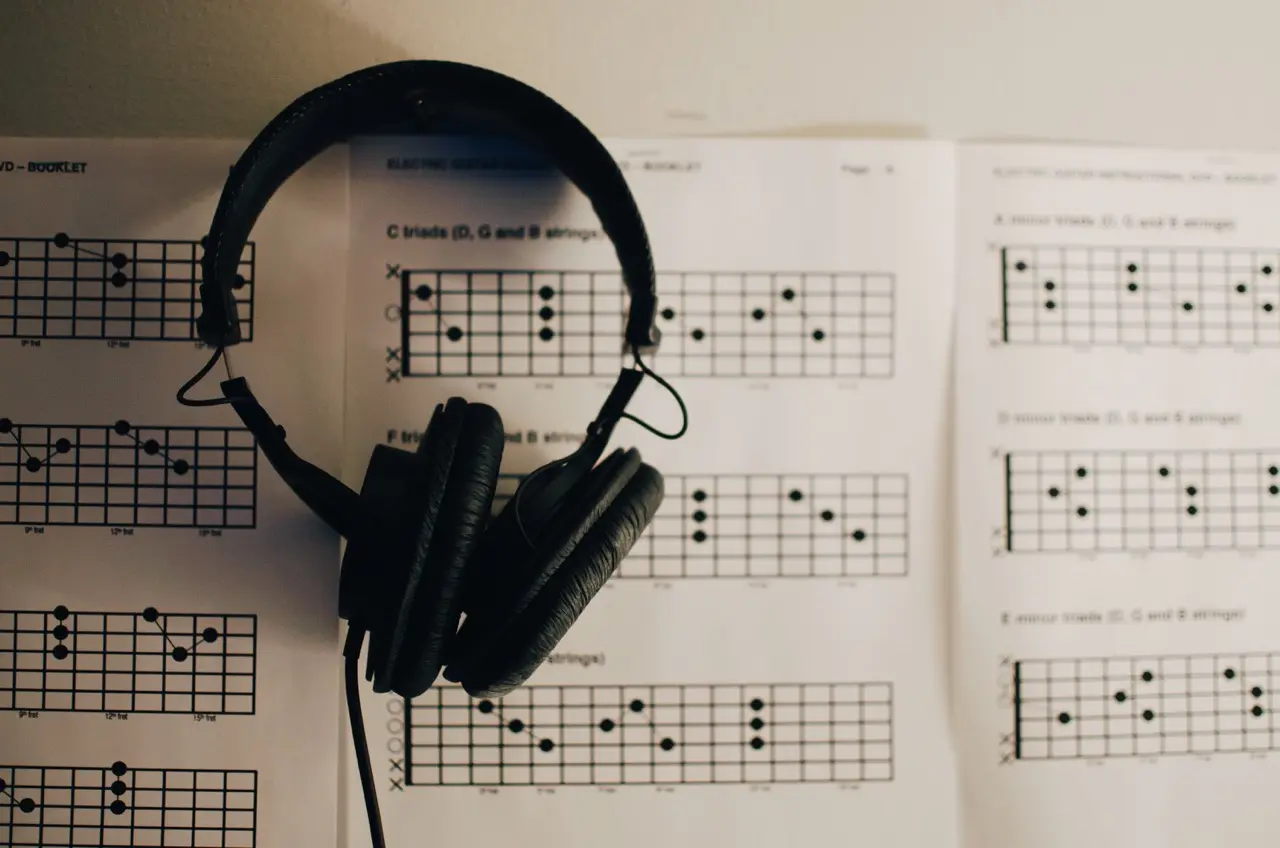
headphones resting on sheets of guitar diagrams all about triads

Guitar lessons often focus on teaching triads, but it’s equally as important to know how to practice triads on guitar. Memorising triad shapes is just the beginning, but in this lesson we’ll build on a simple practice idea that you can incorporate in your daily routine.

This lesson assumes you’re already at least moderately familiar with how to visualise triads on guitar. If this is not something you’re yet confident with, I recommend enrolling in my CAGED Fretboard Visualisation Masterclass for a complete insight into how to visualise the guitar.

Let’s begin working through the steps!

#1: Determine The Chords & Key

Let’s start by selecting two major triads within a specific key. For example, we’ll choose the key of B and the B major triad as our starting point. To create a musical progression, we can select the B major and E major triads – the I and IV chords.

#2: Playing with a Steady Tempo

Set a steady tempo that works for you and play a B major triad on every quarter beat. Maintain this pace for four bars.

TOP TIP: If you find that you’re better at visualising triads vertically on guitar, and not so much horizontally, try to loop one or two triads for a few beats whilst you allow yourself to think and work out a different position of the neck. Once you can visualise triads in your target position of the neck, then take the leap! Horizontal movement can be slow to begin with, but in time when your ability to visualise the guitar strengthens, you’ll become much faster.

Now after 4 bars of E major, move on to to the next chord (B major) for the next 4 bars and play B major triads on every quarter beat.

Rinse & repeat!

#3: Adding Chords & Increasing Difficulty

To add complexity, we can add chords to the progression. To allow yourself to focus on major triads, adding a V chord to the progression would be the smartest decision.

For now, don’t add any other triad types to your progression such as minor triads. We’ll come back to that later once you can be sure you master the major triads.

You may also decide to speed up the progression if you find it to be too easy or slow. Instead of playing 4 bars of each chord, you could play just two bars. If you’re feeling confident with your rhythm, then perhaps you can introduce some eighth notes instead, or off-beat rhythms.

Just don’t run before you can walk!

#4: Minor Triad Variation

Now that you’ve got a good grasp of how major triads look and feel across the neck, it’s time to regress back to step #1 again but now with minor triads. Begin with a i iv progression, Bm to Em.

The goal is to focus on one type of triad during a practice session to maintain clarity and progress.

#5: Putting It All Together

After you’ve become confident with both major and minor triads across the neck, it’s time to blend them together! If you’ve done sufficient preparation, this shouldn’t be too difficult to improvise your way through.

Major and minor triads are the most important triad types to familiarise yourself with. Down the road, you can begin to expand your chord vocabulary with diminished, suspended, and even augmented triads. I would advise that you stick with major and minor for a long while though, as these are the most practical and useful.

Embrace the learning process and enjoy the journey 💜

If you want to deep dive further and not only learn other ways on how to practice triads effectively, but also how to apply them in your music and improvisation, you absolutely don’t want to miss out on my All About Triads Masterclass here on Fretwise! 😉

Remove Unwanted String Noise From Your Bends And Vibrato

remove unwanted string noise

It’s not uncommon for guitar players to struggle with unwanted string noise when performing phrasing techniques such as bends and vibrato.

In the video lesson provided, I’ll demonstrate effective techniques to help you minimise unwanted string noise in your playing. The key technique you’ll learn is left hand muting, which proves to be one of the best ways to address this issue. Below I have summarised the tips from the video for your reference so you can achieve cleaner, more professional phrasing!

Left Hand Technique

There are multiple methods in which you can employ left hand string muting. Here are just a few tips for you to consider in general practice:

  1. Always touch the string above! Most often with your first finger, but also sometimes with your third. Make sure you touch the string above with the flesh of your finger, not the nail.
  2. If you’re playing chords or arpeggios, you should ensure that the fingers on your left hand are arched to allow room for the strings to ring out. You can achieve this better by moving the thumb down on the back of the neck. If you’re playing a melody however, you’ll want to keep your fingers relatively flat. For this, you’ll want to bring the thumb high and almost over the top.
  3. Use your third finger as the leading finger for bending, while the second and first fingers provide support. Ensure that the first finger is slightly higher than the other two, lightly touching the string above to eliminate noise. By maintaining this finger formation, you can achieve cleaner bends with less background noise.
  4. When performing vibrato with the third finger, make sure to keep your first finger stable and flat so that it is muting the neighbouring strings. The first finger does not need to press down on a fret, but instead it should rest gently on the strings.

Right Hand Technique

Now let’s look at the right hand. It’s good practice to use the palm of your hand to mute the strings above the note you are playing. So, for example, if you are playing the G string, try to rest your palm on the E and A strings. It’s better to use the left hand to mute the D string.

Summary

I hope these tips and exercises help you improve your string bending technique and eliminate unwanted string noise. Remember to practice regularly and pay attention to your hand position and finger formation! By incorporating these techniques into your playing, you’ll achieve cleaner and more controlled bends and vibrato.

The Best Way to Visualise Triads on Guitar

the best method for visualising triads on guitar

Are you learning how to visualise triads on guitar, but struggling to see how they fit together across the fretboard? Let me show you the easiest way to visualise triads across the guitar neck!

Just like most of us, I first learned triads from a YouTube video. The teacher even provided accompanying PDF diagrams! For weeks thereafter I practiced them up and down the neck, hoping that eventually I would retain the muscle memory to recall all of the triads with ease. However this goal proved to be unobtainable, as it was too difficult to memorise much more than 10% of the shapes 😓

Years later however, I discovered a much easier method that I use to visualising triads (and, well – everything!) across the guitar neck: The CAGED System.

The CAGED System

If you are unfamiliar with The CAGED System, it consists of five positions or chord shapes that are movable positions across the guitar neck. These positions are based on simple open chords:

C, A, G, E, and D.

Let’s begin exploring what a D chord looks like by identifying the five CAGED positions on the neck. Take note of how each position fits together like a jigsaw puzzle, and pay close attention to the root notes within each shape:

How To Visualise Triads

Now here’s the trick. Instead of memorising every individual triad position as its own, it’s far easier to think of them as subsets of their parent CAGED position!

For example, if you focus on just the bottom 3 strings, whilst keeping the parent shapes from above in mind, these are the note groupings you would practice:

Then once you can visualise these clearly, respective of their parent CAGED position, you can move on to do the same for every other string set!

Summary

Everything I’ve covered in this writeup is relative to the key of D major. In the attached video I also go through examples in C major.

If you want a more comprehensive understanding of The CAGED System including how to practice triads in every key, including minor keys, then take a look at my CAGED Fretboard Visualisation Masterclass! The methods I teach in this course have revolutionised my outlook of the guitar 🤯

By utilising The CAGED System properly, you’ll be able to effortlessly and quickly recall triads during your practice within no time!

The Best Way To Hold A Guitar Pick: With Pictures!

best way to hold a guitar pick

Knowing how to hold a guitar pick properly is a crucial foundational skill in guitar playing – developing good habits here will prevent problems with advanced techniques down the line.

I’ve received countless comments from people who have watched the video above expressing that bad habits have hindered their progress, and that inheriting my tips has tremendously improved their speed and accuracy on the guitar.

I will start this off with an important disclaimer though. I realise that there is no “best way” that suits absolutely everyone! There will always be exceptions to the rule, but the tips I am sharing with you in this post are what I’ve found to be most helpful for the majority of people.

Take what you will from this post, even if it’s just one or two tips. Learning to pick properly will feel a little unnatural at first, just like most new skills. In the early stages of your progression, try to find a compromise between what feels comfortable and what feels right.

A small and strong pick with a sharp tip will set you off on the right track! I’ve tried countless over the years, and I always come back to the Dunlop Jazz III picks.

Picking Grip

First and foremost, hold your pick between your thumb and your first finger. Avoid using two fingers or relying solely on the middle finger. Utilise the thumb and finger for a stable grip.

Make sure the pick rests on the side of your first finger, not the flat part. The tip of the pick should face the same direction as your nail.

A common mistake is pinching the pick between the thumb and finger, in the same way you would pinch your nose.

Instead, aim to create a circle, as demonstrated in the next image.

Keep the other fingers slightly separated from the pick to reduce friction and unnecessary tension. By curling them up, you create a noticeable gap between the second and first finger.

I like to think of holding a guitar pick much like holding a pencil or paint brush.

Wrist & Finger Position

Next, remember to keep your wrist loose and relaxed. Avoid any tightness or tension in this area.

Now that you have a grasp on holding the pick, establish a reference point on the guitar bridge. I like to rest the ball part at the base of your palm on the top of the guitar bridge, and align the entire side of your palm down the bridge.

This position helps with accuracy. Avoid starting with your arm sideways, as it can lead to issues in playing accurately.

By aligning yourself properly with the bridge and having the ball of your hand on top, you’ll increase your chances of hitting the right notes at the right time 😉

Remember that this is a picking lesson, and the same rules don’t apply if you’re strumming. When strumming you do not want to anchor on the bridge. The pick grip remains the same, but there must be no anchor point on the bridge.

Picking Angle

Now that your hand is in the right place, your goal is to attack the strings at a 45 degree pick angle.

Don’t confuse picking direction with pick angle. Picking direction should naturally be vertical – up and down as you cross over the string. Picking angle though refers only to the angle of the pick.

It’s important that both your wrist and fingers are flexible and move with the motion of the pick.

Summary

By combining these reference points and the proper pick hold between your thumb and finger, you’ll establish a solid foundation for picking.

As a beginner exercise, try picking each string individually, gently moving the pick down and up. Focus on these key points rather than speed. Pay close attention to my demonstration in the video.

These tips encapsulate what I believe to be the most beneficial and comfortable methods from my favourite guitar players. I hope they help you as much as they’ve helped me and hundreds of thousands of other viewers around the world!

Keep practicing and good luck with your guitar journey!

When Are Notes Sharp Or Flat?

sharp or flat notes on guitar

Have you ever wondered what the distinction between sharp and flat notes is, and when it’s more appropriate to use – for instance, a Db instead of a C#? They’re the same note right, so why does it matter?

With my demonstrations in the video above, I will help you grasp the contexts in which you should use either a sharp or flat note.

Example 1: Common Practice

If we were to put together an F major scale, would it be:

  • F, G, A, A#, C, D, E; or
  • F, G, A, Bb, C, D, E

When the full scale is written out, it might already seem clear to you which one is the correct answer. The second option uses all letters of the musical alphabet, whereas the first skips a letter which goes against common practice.

Example 2: Theoretical Notes

This rule also applies when a note only theoretically exists. Consider for example the D# harmonic minor scale, which is built from the intervals: 1, 2, b3, 4, 5, b6, 7.

Take note that this is a natural minor scale, but instead with a sharpened 7th degree.

This would be an incorrect interpretation:

  • D#, F, F#, G#, A#, B, D.

Instead, we would do this:

  • D#, E#, F#, G#, A#, B, C##.

Notice that E# is a theoretical note, and while C## is technically the same as D, we can’t skip a letter in heptatonic scales.

Summary

The confusion on whether a note is sharp or flat usually comes from a scenario with no context. If you select a random note on the fretboard, it could for example be either D# or Eb. Without context, it’s unclear. So be sure to understand the context of the music if you’re in doubt!